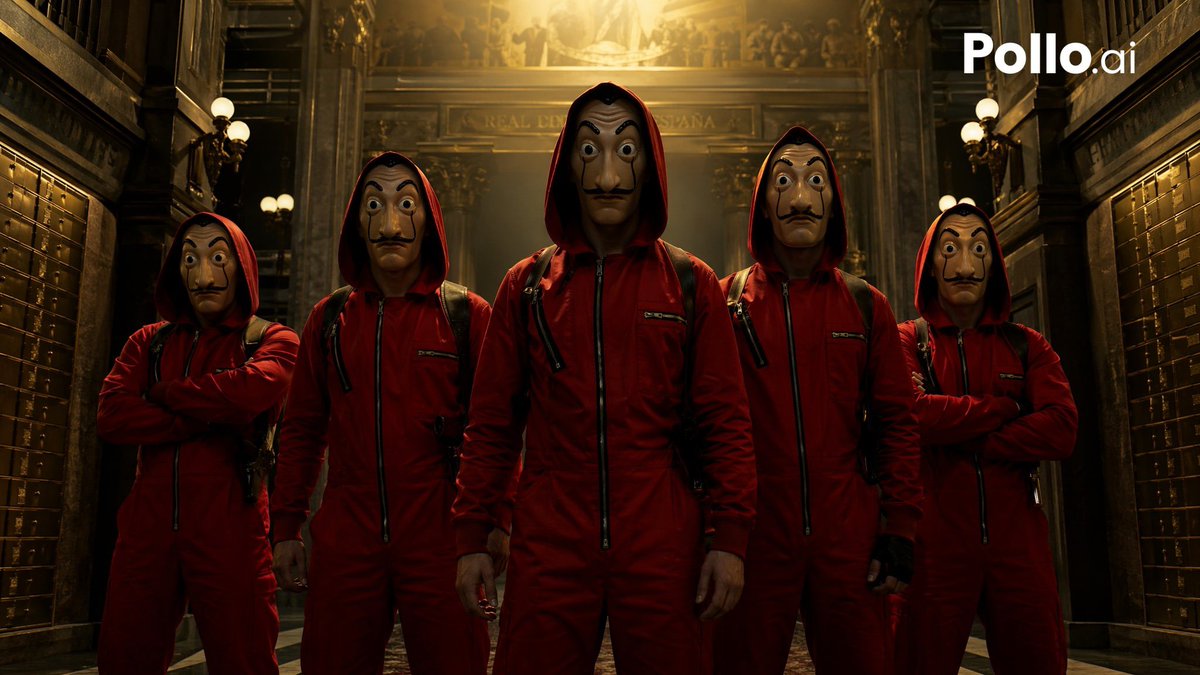
Movie-like red robber team inside the bank
Other prompt · by RoseKhlifa · published 2026-06-09
Prompt
A cinematic, gritty heist-team group portrait inspired by a Spanish crime thriller, showing exactly 5 robbers standing shoulder to shoulder in a grand historic bank interior. The scene is framed symmetrically in a low-angle medium full-body shot, with the tallest figure centered in front as the leader and 2 teammates on each side. All 5 wear identical deep red hooded jumpsuits zipped up the front, black straps and backpack harnesses, and their hoods up, creating a menacing anonymous look. The far-left and far-right robbers stand with arms crossed; the second-left and second-right robbers stand with arms relaxed at their sides; the center robber stands squarely facing camera with hands down and a dominant posture. Their faces are intentionally obscured and featureless, hidden in shadow and blur beneath the hoods. The setting is an opulent old bank hall with dark polished wood, brass safety deposit boxes lining both side walls, ornate columns, balcony railings, classical architectural details, and warm globe lamps. A bright golden overhead light pours down from the ceiling behind the group, creating dramatic backlighting, rim light on the red suits, long shadows, and a tense high-contrast atmosphere. Color palette: crimson red, black, dark brown, brass, and warm gold. Style: ultra-realistic cinematic photography, suspenseful crime-drama poster aesthetic, highly detailed fabric texture, moody lighting, symmetrical composition, shallow haze in the background, sharp focus on the team. Add a white {argument name="watermark text" default="Pollo.ai"} logo in the top-right corner.Example output
Other
How to use this prompt
- 1. Copy the full prompt text above.
- 2. Paste it into your image model — Midjourney, DALL·E, Stable Diffusion, or GPT Image.
- 3. Replace the subject, style or lighting words with your own to adapt it.
- 4. Adjust aspect ratio and steps in your tool; the prompt itself is tool-neutral.
- 5. Iterate on one variable at a time so you can tell which change mattered.