Dali Surrealist Landscape
Landscape prompt · by RoseKhlifa · published 2026-06-09
Prompt
Using REFERENCE_0 as the surrealist style reference, create a new original Salvador Dali–inspired desert seashore scene rather than copying the exact clock composition. Keep the dreamlike realism, long shadows, muted ochre sand, blue horizon, and precise oil-painting finish, but replace the original melting-clock still life with a wider cinematic landscape.

Add these new surreal elements exactly: 1 woman in a long black dress seen from behind at the left foreground; 1 cracked floating egg in the upper-left sky; 3 swan-elephant hybrid creatures standing near shallow water; 4 extremely tall, thin-legged elephant-like figures carrying architectural towers or structures on their backs in the mid-right distance; 1 coastal monastery or castle complex on the far-right hillside; 1 wooden drawer chest in the lower-right foreground with a pale white cloth or hair-like sheet flowing out of it; and 1 large flat muted taupe rectangle obscuring the lower center of the image.

Composition: horizontal 4:3 canvas, low desert plain meeting a calm sea and distant islands, dramatic perspective from left foreground to right background. Use {argument name="style reference" default="Salvador Dali surrealist oil painting"}, {argument name="main foreground figure" default="woman in a long black dress seen from behind"}, {argument name="floating object" default="cracked egg"}, {argument name="hybrid animals" default="three swan-elephant creatures"}, and {argument name="distant giants" default="four long-legged architectural elephants"}. Avoid modern objects, text, borders, and watermarks.
Example output
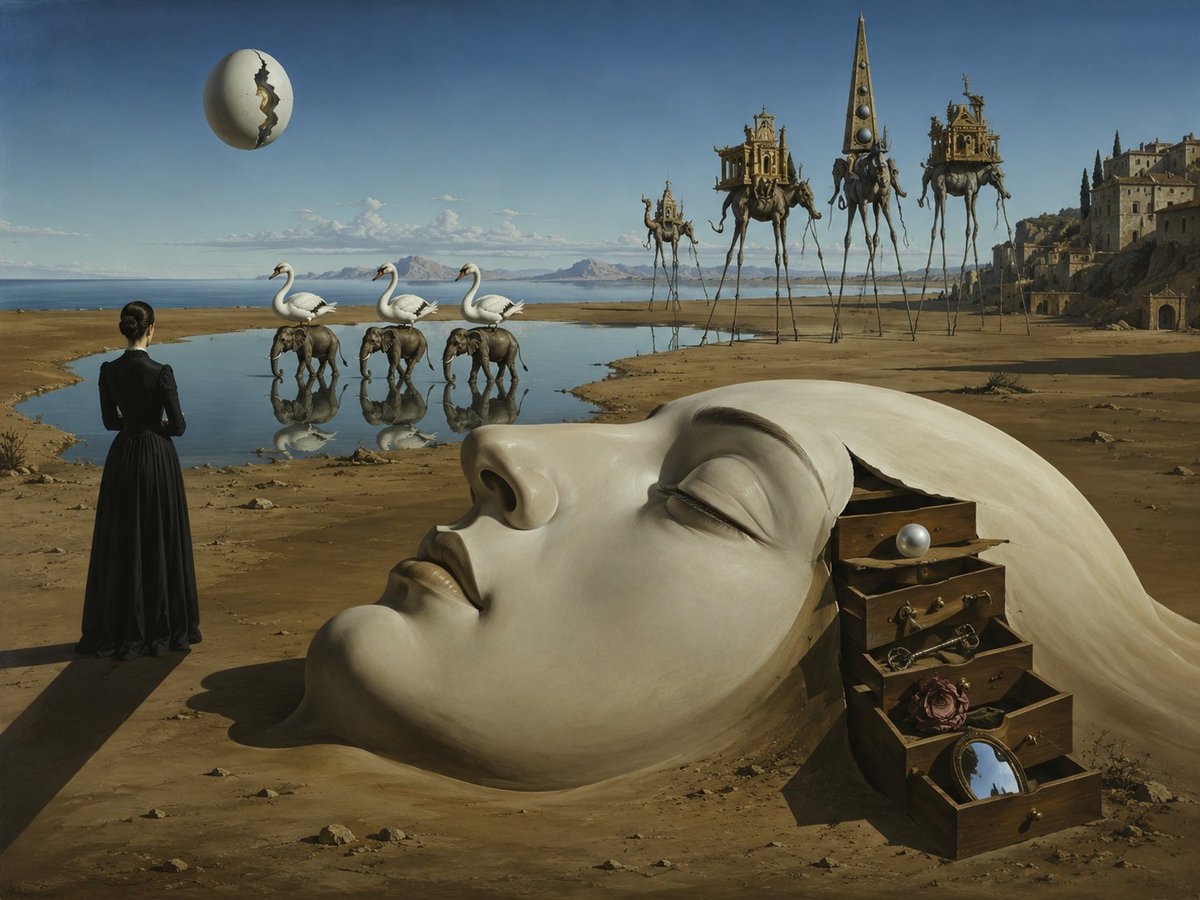
Landscape Scene
How to use this prompt
- 1. Copy the full prompt text above.
- 2. Paste it into your image model — Midjourney, DALL·E, Stable Diffusion, or GPT Image.
- 3. Replace the subject, style or lighting words with your own to adapt it.
- 4. Adjust aspect ratio and steps in your tool; the prompt itself is tool-neutral.
- 5. Iterate on one variable at a time so you can tell which change mattered.