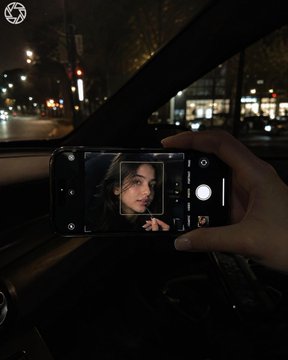
iPhone screen selfie in car at night
Other prompt · by RoseKhlifa · published 2026-06-09
Prompt
The photo was taken inside a car at night; the frame reveals only {argument name="subject detail" default="a woman's hand and an iPhone"}, while the young woman's face is visible solely on the phone screen. The camera is positioned on the passenger side, framed to capture the windshield and the phone, which is being held in one hand directly in front of the person. The hand holds a black, latest-model iPhone Pro in a horizontal orientation; the screen displays the iPhone's front-facing camera interface, complete with visible shutter buttons, focus frames, and UI elements. A close-up of the young woman's face inside the car interior is visible on the phone screen: her lips are slightly parted as she touches her lower lip with a slender black object resembling a lip liner pencil. The woman on the screen is wearing {argument name="clothing color" default="black"} clothing, and the light from the phone softly illuminates her face. The hand holding the phone features long fingers and a short, square-shaped French manicure. The rest of the frame is dark; the car's interior is a premium black finish, with parts of the window and dashboard visible. Outside the window lies a night street—warm, blurred city lights, dark silhouettes of trees, and faint light reflections on the glass. The shot is heavily darkened, evoking a "cinematic night" aesthetic and a "rich lifestyle" mood. (9:16 aspect ratio). Shot on an iPhone at night without flash; realistic photo style with slight motion blur and high-contrast shadows. No filters; do not completely blur the background. The hair appears voluminous.Example output
Other
How to use this prompt
- 1. Copy the full prompt text above.
- 2. Paste it into your image model — Midjourney, DALL·E, Stable Diffusion, or GPT Image.
- 3. Replace the subject, style or lighting words with your own to adapt it.
- 4. Adjust aspect ratio and steps in your tool; the prompt itself is tool-neutral.
- 5. Iterate on one variable at a time so you can tell which change mattered.